Grissini
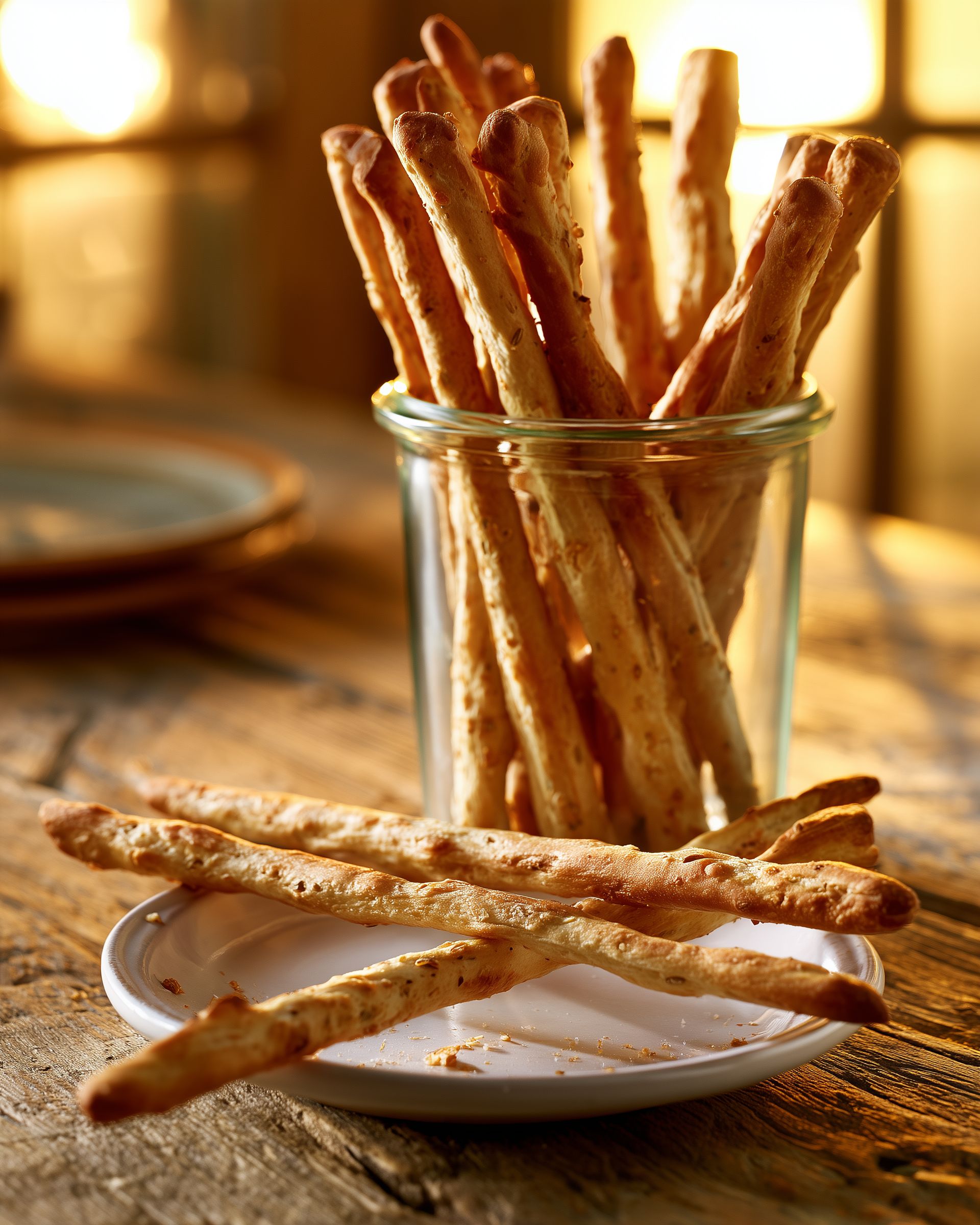
My father will tell this story to anyone who orders these and looks even slightly interested: that grissini were invented in Turin for a duke with a weak stomach, whose doctor demanded a bread that wouldn't sit heavy on him, and that the duke loved the result so much it outlived every other cure his doctor ever prescribed. I have no way of confirming this, and neither, I suspect, does my father. It has never once stopped him from telling it.
Ingredients
- 300g bread flour (or Tipo “0”)
- 180ml warm water
- 2 tablespoons olive oil
- 1 teaspoon instant dry yeast
- 1 teaspoon fine sea salt
- Semolina, for dusting
- Coarse salt, for the top (optional)
Makes about 30 breadsticks.
Cookware Required
- la bilancia da cucina (kitchen scale)
- la ciotola (mixing bowl)
- la teglia (baking sheet (or two))
- il tarocco (dough scraper or a sharp knife, for cutting strips)
Method
Dissolve the yeast in the warm water, and let it sit a few minutes. Combine the flour and salt in a bowl, pour in the yeasted water and the olive oil, and mix until a rough dough forms. Knead for about eight minutes, until smooth.
Cover, and let it rise at room temperature for about an hour, until doubled. There is no need to be precious about the timing here -- this is a forgiving dough, and a little longer or shorter will not ruin it.
Turn the dough out onto a surface dusted generously with semolina, and pat it into a rough rectangle, about the thickness of your finger. Cut it into strips the same width. This part does not need to look tidy. The irregularity is the whole point, and a grissino that looks machine-made has usually been made too carefully.
Pick up each strip by both ends, and gently pull, letting its own weight do most of the stretching, until it's roughly as long as your baking sheet. Lay it down without letting it touch its neighbors, and repeat with the rest.
There is no second rise. Sprinkle with coarse salt if you like, and bake right away at 220°C (425°F) for fifteen to twenty minutes, until deeply golden and dry all the way through -- pick one up and let it cool for a moment before you decide it's done; a grissino that seems crisp hot from the oven can still be soft in the center.
Cool completely on a rack before eating or storing. They keep, in a sealed container, for a couple of weeks, though ours have never once lasted that long.
Quando Va Storto
If they bend instead of snapping once cooled, they needed more time in the oven -- underbaked grissini feel done when hot and turn chewy as they cool, which is the opposite of what you want; next time, bake a few minutes longer and trust a deeper color than feels natural. If they're tough instead of light, the dough was overworked while shaping, or stretched too roughly; handle it gently, and let gravity do the pulling instead of your hands. And if they bake unevenly, thick in some spots and thin in others, that's honestly fine -- these are meant to look like ten different people made them, because in this kitchen, they usually were.
Una Storia dalla Sala
A man worked through three full breadbaskets of grissini before his appetizer had even arrived, and when Rosa mentioned, as kindly as she could manage, that a fourth basket would go on the bill, he became genuinely furious, demanding to know what kind of restaurant charges a paying customer for bread. My father came out from the kitchen, listened exactly as long as courtesy required, and explained, with the particular calm he reserves for customers he has already decided not to like, that the first two baskets had been the house's pleasure, the third had already been a quiet gift, and no fourth basket has ever, in the history of restaurants, been owed to anyone by right.
The man left in a fury, without paying for anything he'd actually ordered yet, and never returned. Nobody in this family has ever considered that a loss.